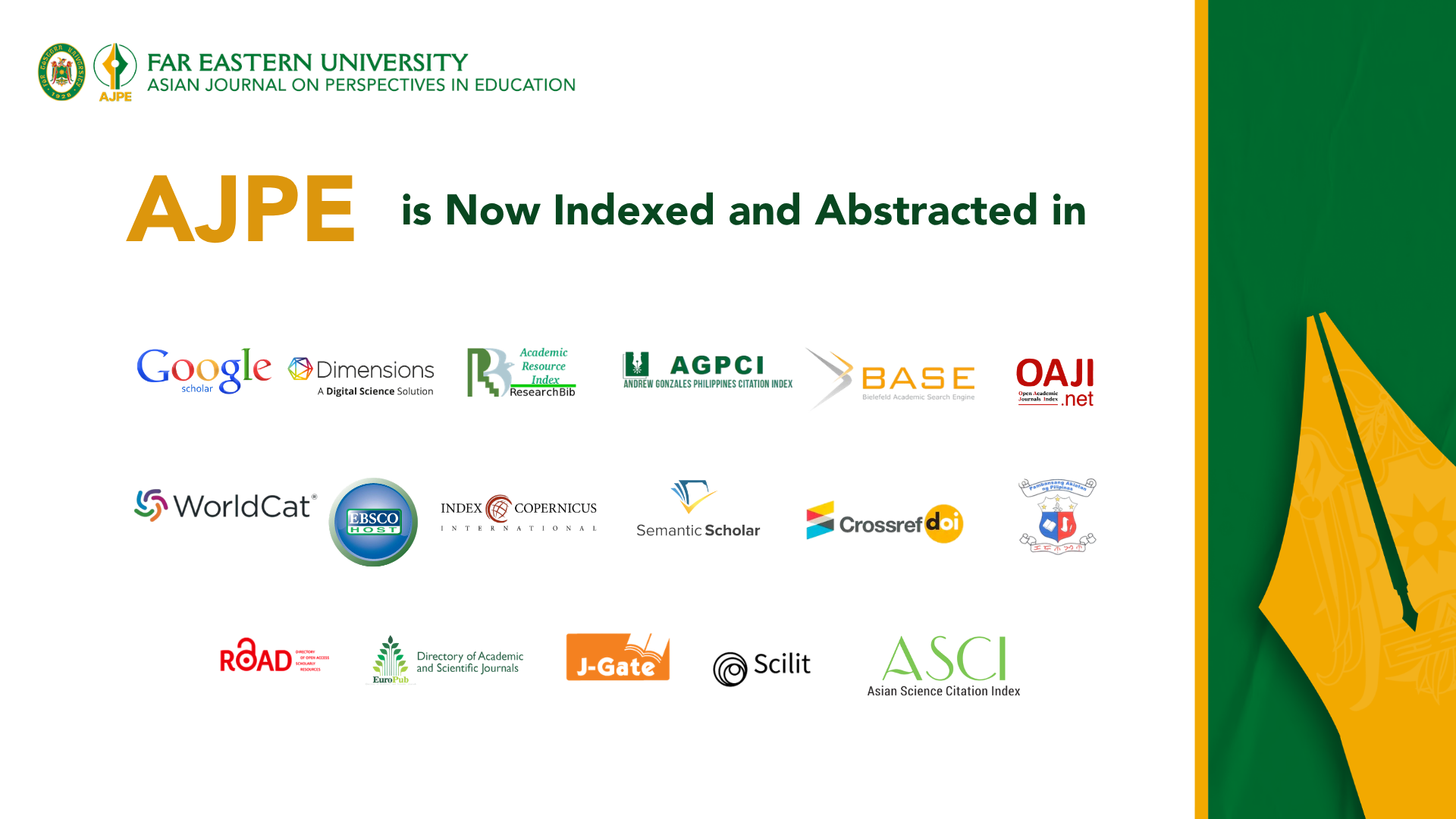
Far Eastern University’s Asian Journal on Perspectives in Education (AJPE) is now included in the Asian Science Citation Index (ASCI), marking another milestone in its continuing efforts to broaden the international visibility and discoverability of the research it publishes.
This inclusion in ASCI adds to AJPE’s presence in Google Scholar, EBSCOhost, ResearchBib Academic Resource Index, Andrew Gonzales Philippine Citation Index, BASE, Philippine National Library, Scilit, Crossref, Dimensions, Index Copernicus, Semantic Scholar, J-Gate, Directory of Open Access Scholarly Resources, Open Academic Journals Index, WorldCat, and EuroPub.
Expanding this indexing presence supports AJPE’s goal of ensuring that the research it publishes can be more readily discovered, accessed, read, and cited beyond its immediate institutional and national communities. It also creates opportunities for studies addressing educational issues in the Philippines, Asia, and other contexts to contribute to broader scholarly conversations.
With its inclusion in ASCI, AJPE is now indexed and abstracted in 17 national and international databases, indexing systems, and scholarly discovery platforms. The milestone reflects the journal’s sustained efforts to strengthen its editorial practices, expand the reach of its publications, and connect education research from the Philippines and other contexts with wider scholarly communities.
The ASCI is a multidisciplinary scholarly indexing and citation database that seeks to enhance the visibility and impact of academic journals. Its journal evaluation considers areas such as editorial and peer-review quality, originality and academic impact, publication consistency, publishing ethics, international authorship diversity, and citation influence.
For Dr. Rosarito T. Suatengco, AJPE editor-in-chief and research fellow at FEU, the journal’s growing international presence creates opportunities not only for AJPE but also for the researchers whose scholarship it publishes.
“Being included in the [ASCI] is another important step in bringing the research we publish to a wider scholarly community. With AJPE now visible across [several] indexing and discovery platforms, we hope to create more opportunities for Philippine education research, alongside scholarship from Asia and beyond, to be discovered, read, cited, and engaged with internationally. Moving forward, we will continue to strengthen our editorial and peer-review standards, expand our international reach, and uphold our commitment to Diamond Open Access so that high-quality research remains accessible to both authors and readers,” Suatengco said.
As a Diamond Open Access journal, AJPE makes all published articles freely available to readers while charging authors no submission fees, no article processing charges, and no publication fees. Its integration with Crossref also enables the assignment of Digital Object Identifiers, supporting the permanence, traceability, and citability of its publications.
Alongside these developments, AJPE continues to strengthen research and publication capacity through its write-shops, research webinars, mentorship activities, and other scholarly initiatives. These efforts complement the journal’s commitment to rigorous peer review, responsible editorial practice, accessible knowledge, and quality education research.
The inclusion in ASCI further advances FEU’s commitment to research excellence, internationalization, and knowledge sharing, while providing authors with an increasingly visible platform for contributing to local, regional, and international education scholarship.
Scholars may read AJPE and submit their research at https://ajpe.feu.edu.ph/index.php/ajpe
#AJPE #FEU #DiamondOpenAccess #OpenAccessResearch #ResearchExcellence #Internationalization #ScholarlyPublishing #SDG4QualityEducation #SDG17PartnershipfortheGoals