We remain committed to equal opportunity, inclusivity, and diversity, and are guided by our core values of Fortitude, Excellence, and Uprightness. As we approach our centennial in 2028, FY2026 shows how those commitments translate into results across the Group.
Our approach to sustainability is intentional and strategic, and it begins with what we have always done best, which is to educate. Everything else in this section exists to keep that mission strong for the long term: the financial strength that gives us room to invest, the governance that protects both that capacity and the trust our stakeholders place in us, the people who bring the mission to life every day in classrooms and offices across our campuses, the care we take to run those campuses responsibly, and the research and community partnerships that carry what we know well beyond our gates. At the heart of it all are our students, and our commitment to widen their access to learning, to sustain the quality of what they learn, and to walk with them from admission to professional life.
FY2026 was a year in which growth and discipline went together. More students joined us, and more of them were supported by financial assistance, which grew faster than enrollment itself. Revenue rose for a third consecutive year even as we absorbed higher operating costs and continued to invest in our campuses. Our environmental program, now more than a decade in the making, gained a firmer and more rigorous measurement baseline, our community programs were recognized at the national level, and our governance was honored with a Two Golden Arrows Award. We share these results with gratitude to the faculty, employees, students, partners, and communities who made them possible.
This section is prepared with reference to the SEC Sustainability Reporting Guidelines, selected GRI Standards and the UN Sustainable Development Goals, and covers the nine legal entities in our FY2026 SEC filing. Environmental figures reflect a FY2026 recalculation and data-quality review; where a measure remains preliminary or partial-year, we say so. Education and access, governance and ethics, institutional resilience, climate and resources, people and inclusion, and research and communities are the six connected priorities through which we report.

ECONOMIC
Growth with Discipline
The financial position of FEU and its subsidiaries continues to give the Group the stability and readiness it needs to pursue its mission with confidence. Audited consolidated revenue reached ₱5.958 billion in FY2026, up 3.8% from the prior year and 9.7% over two years, as enrollment grew and our newer campuses matured. The year also brought a real operating challenge, which we would rather name than gloss over: expenses grew faster than revenue, rising 13.7%, so that operating income eased by 14.8% to ₱1.542 billion and net income by 4.4% to ₱1.998 billion. FEU remained solidly profitable and financially strong throughout, and the experience has sharpened our focus on operating efficiency as we continue to grow.
Our balance sheet strengthened further over the year, with total assets reaching ₱20.839 billion and total equity ₱17.498 billion, supported by cash and cash equivalents of ₱2.569 billion, a current ratio of 2.46 times and interest coverage of 42.48 times. With low leverage and strong liquidity, the Group can honor every obligation as it falls due while still funding the long-term improvements our students and faculty deserve. That is exactly what we did: cash used to acquire property and equipment rose to ₱1.278 billion, an 88.6% increase over two years, with a further ₱1.222 billion in construction in progress at year-end.
Growth is broadening beyond Manila. Revenue from outside the National Capital Region reached ₱892.1 million, up 19.0% in the year and 41.9% over two years. A wider footprint diversifies our economic base while extending educational capacity to more communities.
FEU generated ₱7.376 billion in direct economic value and distributed ₱6.163 billion of it, or 83.6%. The largest share,
₱2.204 billion, went to our employees in wages and benefits.
Suppliers and operating costs accounted for ₱2.210 billion, providers of capital ₱839.8 million in dividends and interest, government ₱367.2 million in taxes, and community investment, primarily scholarships, ₱541.745 million. Of the procurement budget for significant locations of operation, 98% was spent with local suppliers.
ENVIRONMENT
A More Measured Path to 2028
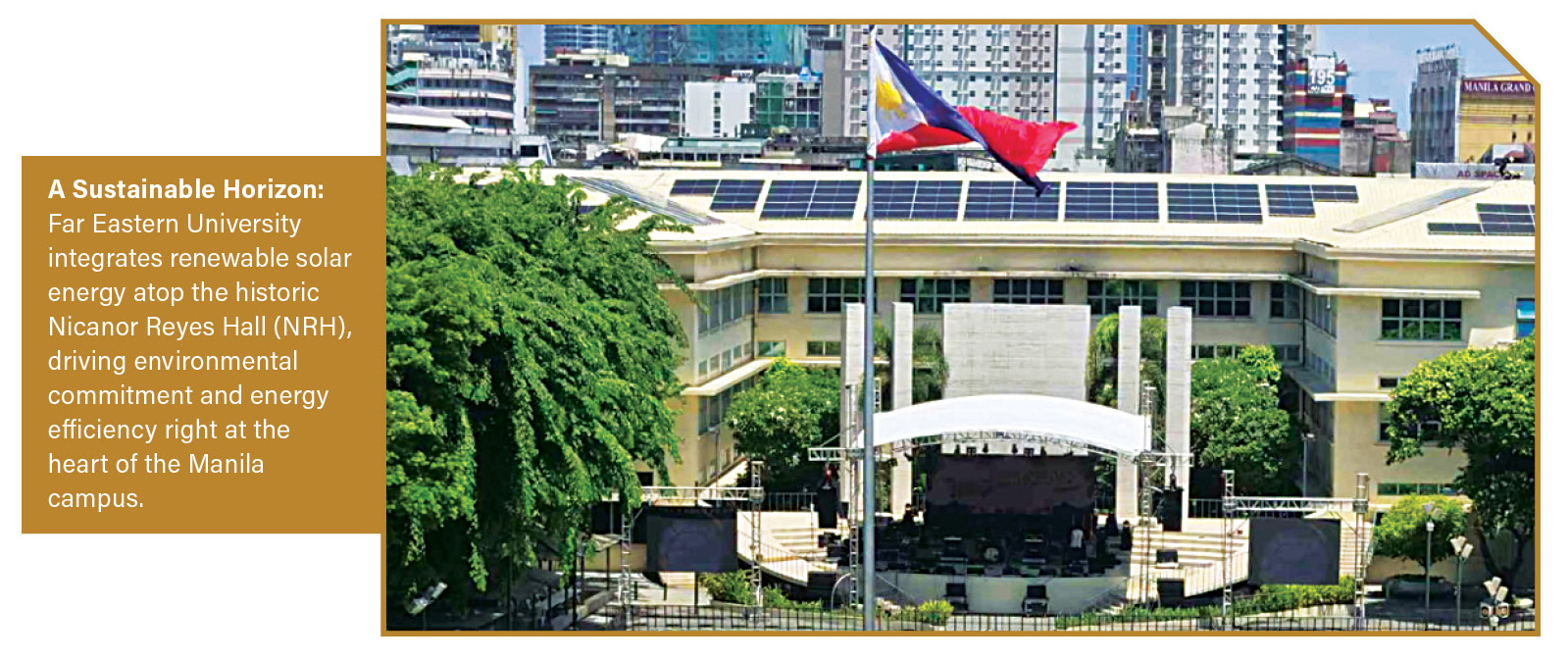
FEU’s commitment to the environment has been building for more than a decade, and each step has made the next one possible. The centralized district cooling and energy-efficiency work we began in 2015 now serves virtually the entire Manila campus. We began sourcing renewable electricity in 2017. In 2023, FEU Alabang became the first academic building in the Philippines to earn EDGE certification, and the FEU Administration Building, a National Cultural Treasure, earned the same distinction that year, proving that heritage and efficiency can live under one roof. In March 2026, the Environmental Management Bureau of the DENR recognized that journey with the Gawad Kabalikat sa Kapaligiran, honoring the way our students, faculty and partner communities have made environmental stewardship a shared endeavor.
FY2026 adds a quieter but equally important milestone. This year we completed a thorough recalculation and data-quality review of our environmental records, and we chose a deliberately conservative method, recognizing renewable energy only up to what we actually consumed so that our share is never overstated. The result is a firmer baseline than we have ever had, and it is the ground on which we will measure our progress toward 2028.
The Group consumed 12.3 million kWh of electricity in FY2026. After renewable supply and on-site solar generation were reconciled against actual consumption, 11.94 million kWh, or 97.08%, is recognized as renewable.
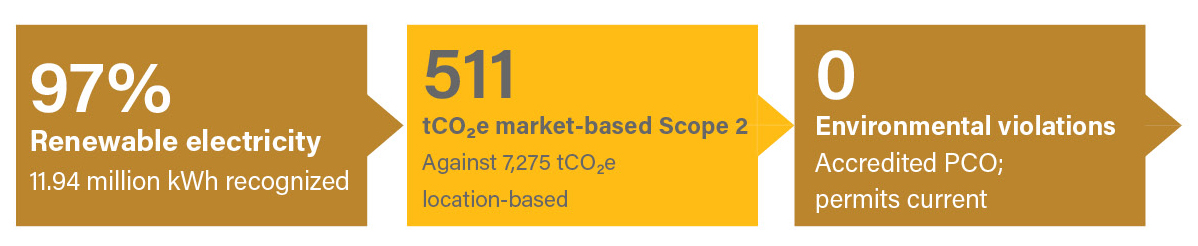
On that basis, preliminary Scope 2 emissions were 511.39 tCO₂e on a market-based approach, against 7,274.85 tCO₂e had the same electricity come from the grid. Scope 1 combustion emissions totaled 201.75 tCO₂e, almost all from the vehicle fleet; refrigerant emissions are not yet quantified and are excluded rather than reported as zero. 24.6 tonnes of recyclables were recovered. Water consumption of 170,113.50 m³ is a partial-year figure, and completing campus records is a priority for FY2027.
FEU reported no environmental fines, violations or enforcement incidents during the year.
SOCIAL
Education and Our People
For FEU, sustainability begins in the classroom, with the opportunity we create for young people to learn, to grow and to carry what they have gained into their families, their professions and their communities. In FY2026, that opportunity reached 53,618 students across our seven operational schools, 7.2% more than in FY2023. We are especially proud that financial assistance grew faster than enrollment: 13,747 students, more than one in four, received scholarships or other support, with needs-based assistance the largest component at 7,257 students. External scholarships have more than quadrupled since FY2023, from 503 to 2,159 beneficiaries, thanks to 38 grantors and programs who share our belief in these students. That access rests on recognized quality: FEU holds CHED Autonomous Status for 2024–2027 and institutional accreditation from the ASEAN University Network, and FEU Manila conferred degrees on 5,024 graduates in 2026.
Our students are supported throughout by University Health Services and by FEU Healing Spaces, which provides voluntary, consent-based psychological support with referral pathways for specialized care.
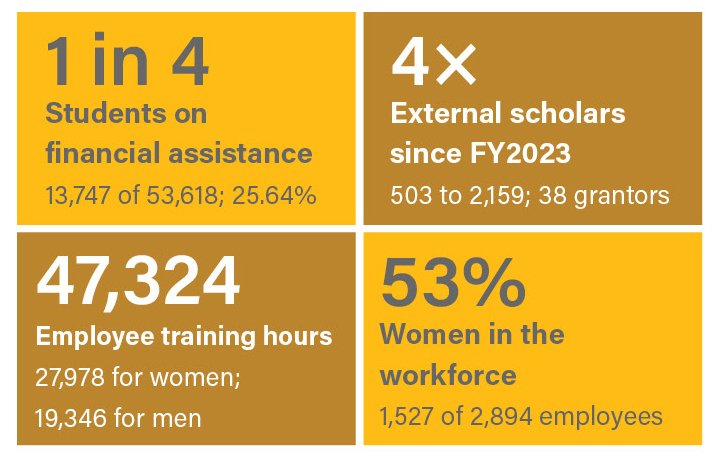
None of this happens without the people who make FEU what it is. Our 2,894 employees, 53% of them women, received 47,324 hours of training during the year, and they are supported by benefits that go beyond what the law requires, by collective-bargaining
coverage of 35%, and by seven employee-policy consultations that keep the conversation between management and employees open. We also extend our educational mission to our own people through scholarships, tuition subsidies and support for graduate study. FEU recorded 21 safety drills, 15 work-related injuries and zero fatalities, and Healing Spaces is available to employees as well as students.
Inclusion is built into policy: fair and nondiscriminatory employment practices, a Gender and Development Desk established in 2018, and institutional policies including the All-Gender Restroom, Multi-Faith Room, and Diversity and Inclusion Policies.
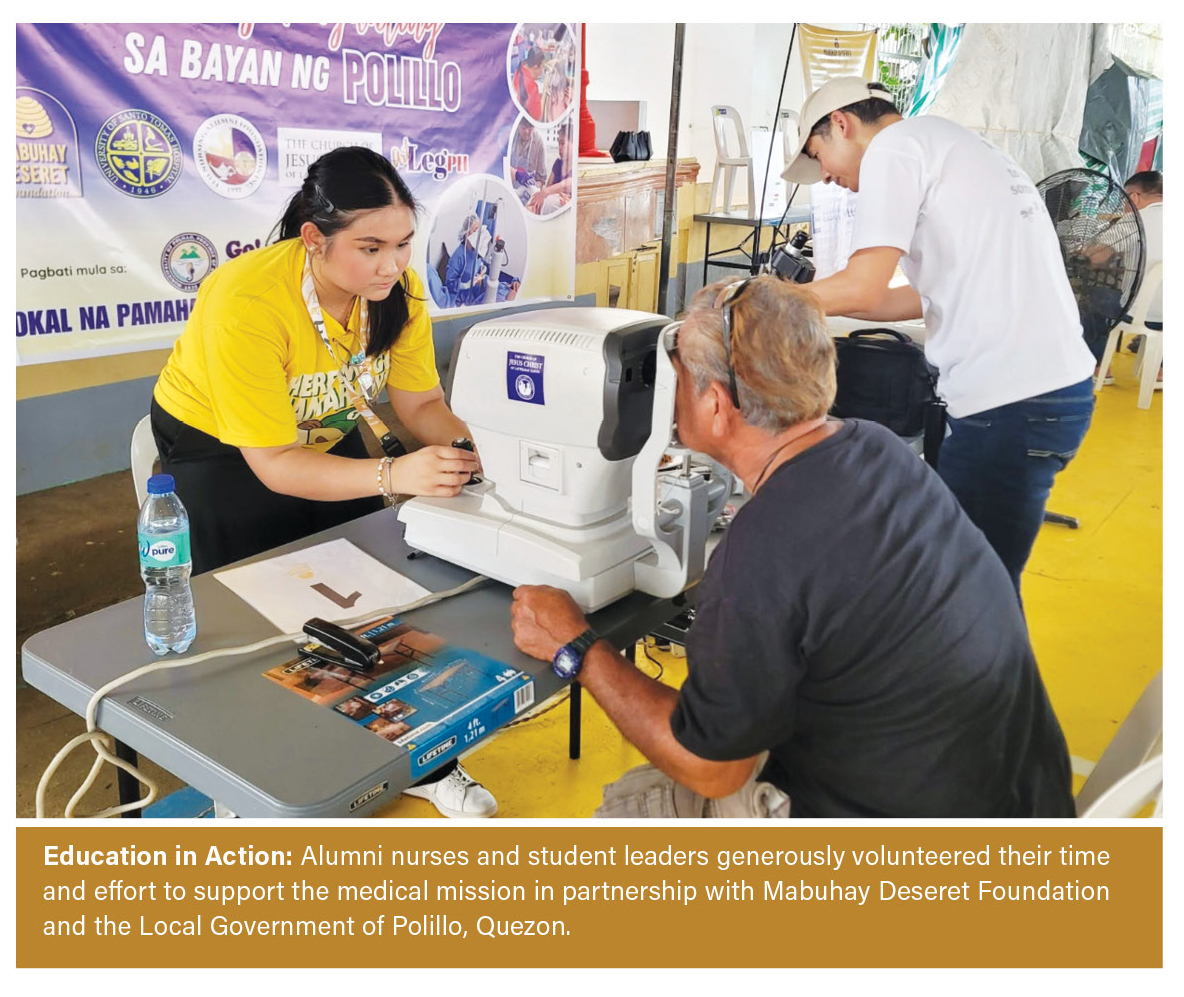
Education in Action
Our community extension work is where FEU’s teaching, research and professional expertise meet real needs beyond the campus, and where our Tamaraw volunteers show what service looks like in practice. Project HOPE, Harnessing Offenders’ Personal Empowerment, serves women persons deprived of liberty at the Manila City Jail Female Dormitory through livelihood, psychological support, medical services, literacy, rights awareness and preparation for reintegration. In FY2026 it delivered 34 programs to 1,341 recipients, and in October 2025 the People Management Association of the Philippines named FEU one of three national recipients of its People Program of the Year award for Bread of HOPE, which pairs training in sanitation, kitchen safety, baking, packaging and costing with real production, and has now added barista training through Pasibol Coffee.
Project Mangyan works with Mangyan scholars at the Mangyan Education Center and with Hanunuo and Buhid communities in Mindoro, combining livelihood, youth development, cultural documentation and support for the learning environment. Across three immersions and 10 programs reaching 231 recipients, FY2026 saw 52 women bead makers and 16 weavers at work, 2,339 beadwork products purchased by the FEU Bookstore, and a ramit fashion collection in development. When disaster struck, FEU relief packs, hygiene kits, and a community soup kitchen reached more than 1,400 families and mobilized ₱190,000 in donations.
These programs run on volunteerism. Project HOPE drew 209 faculty, 307 student, 41 staff and three alumni volunteers, and Project Mangyan a further 29 faculty, 45 students and eight staff. Our research reaches outward too: FEU’s environmental research portfolio of 27 Scopus-indexed publications with 73 citations spans water, climate, marine systems and biodiversity, and the Mindoro Priority Impact Research Initiative links that work directly to the communities Project Mangyan serves.
GOVERNANCE
Uprightness in Practice
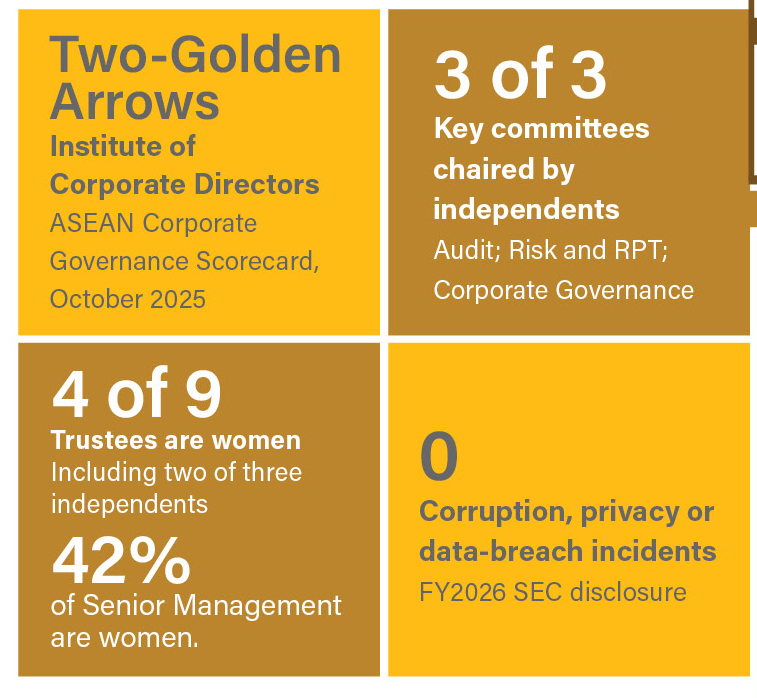
Good governance is how we keep faith with everyone who depends on FEU, and as both a university and a publicly listed company, we hold ourselves to the standards of each. On 23 October 2025, the Institute of Corporate Directors conferred a Two Golden Arrow Award on FEU, extending a record of Golden Arrow recognition that stretches back through 2019 and 2023.
Grounded in the ASEAN Corporate Governance Scorecard’s assessment of shareholder rights, transparency, Board responsibility, and sustainability and resilience, FEU remains the only publicly listed company among the country’s top universities.
Stockholders elected nine trustees in October 2025. Seven are non-executive and three are independent, and four are women, including two of the three independent trustees. Independent trustees chair the Audit Committee, the Joint Risk Management and Related Party Transaction Committee and the Corporate Governance Committee, and material related-party transactions require a two-thirds Board vote with the approval of a majority of independent trustees. Board development this year ranged across corporate and risk governance, human capital, anti-money laundering, sustainability, data science and artificial intelligence, reflecting how quickly the questions before a university board are changing.
FEU’s Senior Management comprises 52 leaders, with 22 women representing 42% of group. This reflects FEU’s commitment to diversity, inclusive leadership, and equal opportunities for career advancement, while fostering a management culture grounded in accountability, integrity, and good governance.
Sustainability now has a clear chain of accountability. The Board sets direction under Aspiration 2028, our medium-term framework for integrating environmental, social and governance priorities into institutional planning. A CFO-led, cross-functional Sustainability Committee brings academic, facilities, finance and corporate affairs functions together with external expertise, while campuses translate those priorities into workplans and evidence. Enterprise risk management, led by the Chief Risk Officer with registers at corporate, institute and department levels, and an Internal Audit function reporting to the Audit Committee, complete the system. Integrity is embedded in everyday conduct through our Code of Business Conduct and Ethics, Conflict of Interest, Insider Trading and Whistle Blowing policies, and FY2026 recorded no corruption-related disciplinary outcomes, no substantiated privacy complaints and no data breaches.
We have said before that sustainability makes business sense. FY2026 shows what that means in practice. That is the foundation on which FEU will enter its second century.